Hier finden Sie die deutsche Übersetzung des Interviews.
DOMRADIO.DE: What is your experience of synodality in your archdiocese?
Cardinal Oswald Gracias (Archbishop Emeritus of Mumbai): Synodality is something which, as I mentioned in my talk, the Church in Asia has already been living to a great extent. I would not say so much in Mumbai, as in certain parts. In some countries it is even more developed than what you are doing here. It has been accepted as a call of Vatican II to involve everyone.
In my own archdiocese, Mumbai, where I have just retired, I had appointed one of the auxiliary bishops to take care of synodality. He formed a team and worked with the diocese and different groups, meeting them regularly, and from time to time they reported back. It worked very well.
For the first time, many people felt that they belonged to the Church. They felt the Church recognised them. I was very touched by that. There were youth, couples, people who had left the Church and were no longer coming. I was especially touched when even transgender people met me and said: Cardinal, thank you for recognising that we are members of the Church, for appreciating us, and for asking us.
So, it has been widely accepted. It is effective, it is working well. And I think we have to take it further, more intensively, more objectively, looking at how we can improve our Church structures, our Church policies and include more and more people. There is still much work to be done.
DOMRADIO.DE: What can the world learn from your experiences in your archdiocese?
Gracias: I would say, first of all, we bishops must reach out. People want to be called, they want to be involved. There is a natural desire to participate in the Church. We must make use of this possibility, so that we can really move forward.
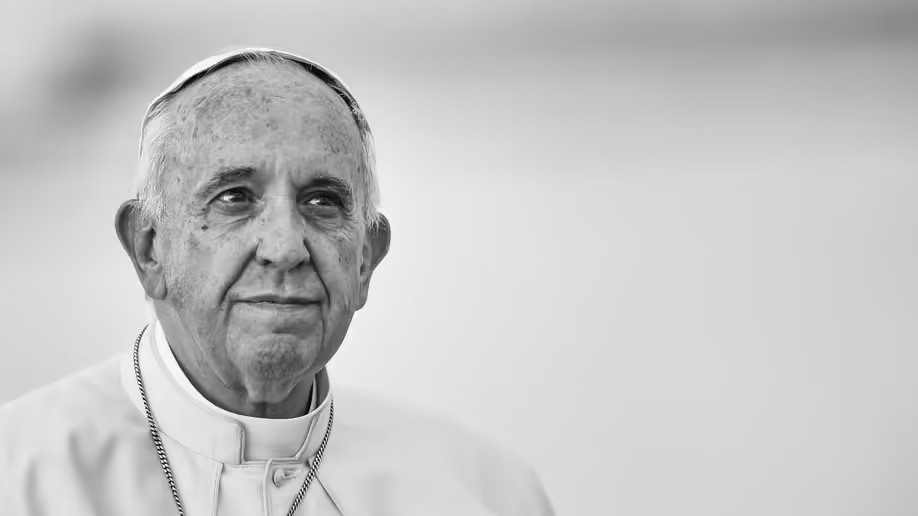
I think Pope Francis has made a tremendous contribution, guided by the Holy Spirit, in leading the Church in this direction. In a way, we are already late, but it is never too late.
DOMRADIO.DE: Do you think we are on the right course that Pope Francis has set?
Gracias: I have absolutely no doubt about that. This was his insight after studying the documents of Vatican II, his insight into the future of the Church, and into its calling. I am thinking especially of the youth. The youth want to participate in building the Church. I was present at the Synod on Youth and saw how enthusiastic they were. Their call was: accompany us, allow us to make mistakes, but correct us, hold our hand and help us.
So, the Church should be sensitive to their needs. We should adapt our methods and our approach to them, so that we are accepted by them and heard by them. Then, we can lead them to a closer relationship with the Church, with our Lord, and with the world, as a service to the world.
DOMRADIO.DE: How do you look at the German Synodal Way?
Gracias: I have had the opportunity to speak with German bishops, with the leadership, and even to address the whole assembly briefly. Personally, I am comfortable with it. I know there is criticism, but I do not see danger.
I even shared my observations with the Holy Father, Pope Francis. I feel that this is also a way of synodality. It is an inculturated way of synodality, the German way. I trust the German bishops to ensure that it remains within the doctrine of the Church and contributes to the Church.
We all make mistakes. I appreciate what they are doing. I do believe the Magisterium and the Holy Father should have the final word. I think this is the way forward. Synodality should not be uniform. Every continent, every country, every culture will have its own way. Africa will be different from Asia, Asia different from Latin America, and Latin America different from Europe. That reflects the richness of the world and of our cultures. So, I am not afraid. I am confident that things will work out well.
DOMRADIO.DE: What is the common ground of synodality across all these perspectives?
Gracias: The common ground is the theology. The Holy Spirit speaks to the whole Church. Everyone is voicing God’s will. And God is leading the Church in a particular direction, each according to their circumstances. I come from Mumbai, a very Westernised city with modern communication. That is different from other dioceses in India, with different cultures, languages and mentalities.
So, the common ground is this: the Holy Spirit speaks to the people of God, we listen, the leadership listens, we pray, we discern, we remain open. Not a closed mentality. This is not acceptable.
I would say: trust the people, have faith in the people. Ultimately, it is also faith in the Church. The Church had, has and will have ups and downs, but it moves forward, adapting to the circumstances, the thinking and the needs of the time.
DOMRADIO.DE: Thank you very much. Is there anything you would like to add?
Gracias: I feel personally grateful. I was present when Pope Francis first spoke about synodality at the Jubilee of the Synod of Bishops of Saint Paul VI. At that time, he gave a very theological address. Gradually, through discussions, it became clear that this was his theological insight, which he wanted to translate into practical application and guide the Church in a certain direction.
We have to thank Pope Francis for this great devotion. I pray that he continues to guide the Church and helps us to understand the synodal way and to live it more effectively. Thank you very much. God bless you.
The interview was led by Maximilian Helmes.