


DOMRADIO.DE: It’s actually unbelievable that the American president has been speculating for months about whether the US should buy Greenland or even invade it militarily. How are people in Greenland reacting to the debate? Are they very concerned?
Father Tomaž Majcen OFMConv, Parish priest in Nuuk: People in Greenland are very surprised and concerned by these discussions — and not just lightly, but in a way that touches their sense of identity and future. Recently, our Prime Minister publicly declared that “we choose Denmark… we choose NATO… we choose the EU” and insisted clearly that Greenland is not for sale. This was in response to renewed talk from the U.S. leader about acquiring Greenland, even hinting at force.
In everyday life here, people speak about it with a mix of worry and quiet determination. Many feel that outsiders are suddenly talking about their home as if it’s property on a market, which rubs against deep feelings of self-determination. Some folks feel anxious, especially when such comments come from powerful figures. But there’s also a proud confidence in our right as a people to decide our own future — most would strongly oppose becoming part of another country.
DOMRADIO.DE: You are the pastor of the only Catholic parish in Greenland. How much is the issue with the US discussed in your parish?
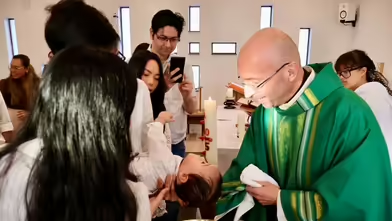
Father Tomaž: In our parish, the issue does come up, but not as political debate so much as a human question of safety, dignity and peace. After Mass, in the community hall or quietly over coffee, people talk about their fears, confusion, and hopes for the future. Some are worried about what all this talk does to children’s sense of security, some wonder how it affects our jobs or families.
My role isn’t to weigh in on geopolitics, but to listen — to hear those concerns and gently help people put them into the context of faith: what does it mean to be a community of love and trust when the world feels uncertain? We pray together for wisdom for our leaders, for peace between nations, and for strength in our small community.
DOMRADIO.DE: There are only a few Catholics in Greenland. What is your life like as a religious minority in Greenland?
Father Tomaž: Life as a Catholic here is beautiful in its own simple way — but it’s also very different from most places. There are only about 500 Catholics in the whole country, a tiny fraction of Greenland’s roughly 57,000 people, and Christ the King Church in Nuuk is the only Catholic parish.
Most people here are Lutheran, and many don’t think much about religion at all. I get to know people from all walks of life — fishermen, teachers, young families, workers from the Philippines and other countries — and we gather here mostly in English or Danish.
Being a minority means you learn to listen more than you speak, to serve without expectation, and to treasure every moment of shared faith. There’s a special joy in baptism, in first communion, in little pilgrimages out to remote settlements — and also a challenge in being present when the distances and weather are so vast. But that’s part of our calling here: to be a small but faithful light in this wide, icy land.
DOMRADIO.DE: There is repeated speculation about whether the US actually wants to take Greenland by military force. As a pastor, how can you help the people of Greenland in this situation?
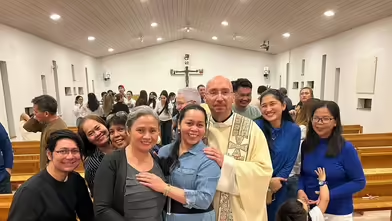
Father Tomaž: My first priority is to offer calm and hope in a time when international talk can feel loud and frightening. I cannot solve geopolitical tensions, but I can help people carry their fears with trust in God. I remind people that we are not alone, that our community is strong, and that God walks with us even when nations debate our homeland.
I also try to provide a prayerful space, where people can bring their anxieties — especially for their children and loved ones — and place them in the context of God’s peace, not fear. We pray for leaders, for peace, for respect of human dignity. And I encourage respectful dialogue, not panic.
In practice that means: listening to people’s stories, offering pastoral care, inviting people to pray together for peace and justice, and reminding everyone that our true home is in Christ.
DOMRADIO.DE: What can we do on the European mainland? Do you feel enough solidarity from other Europeans?
Father Tomaž: From here in Greenland, I do feel solidarity from many European friends, but I also sense that most people on the mainland aren’t fully aware of what this discussion means to a small community like ours. Europe has spoken up politically — Denmark, the EU and NATO partners have publicly supported Greenland’s right to decide its future — and that support is deeply appreciated.
At the personal level, Europeans can pray with us, remember us in your communities, and help the wider world see that Greenland is not a chess piece but a people with culture, dignity, and future dreams. Most importantly, solidarity means standing with our right to self-determination and listening when we say: “We choose who we want to be.”
So yes, there is solidarity — but there is always room for more human connection, more prayer, more awareness of the fragile beauty and deep faith of this land.
I want to invite you to pray for peace and respect for sovereignty, and to join us in caring for creation, especially our fragile Arctic environment, which is one of God’s most breathtaking but vulnerable masterpieces.
The questions were asked by Mathias Peter.


